What Causes a Bulovia Spaceview to Run Really Fast
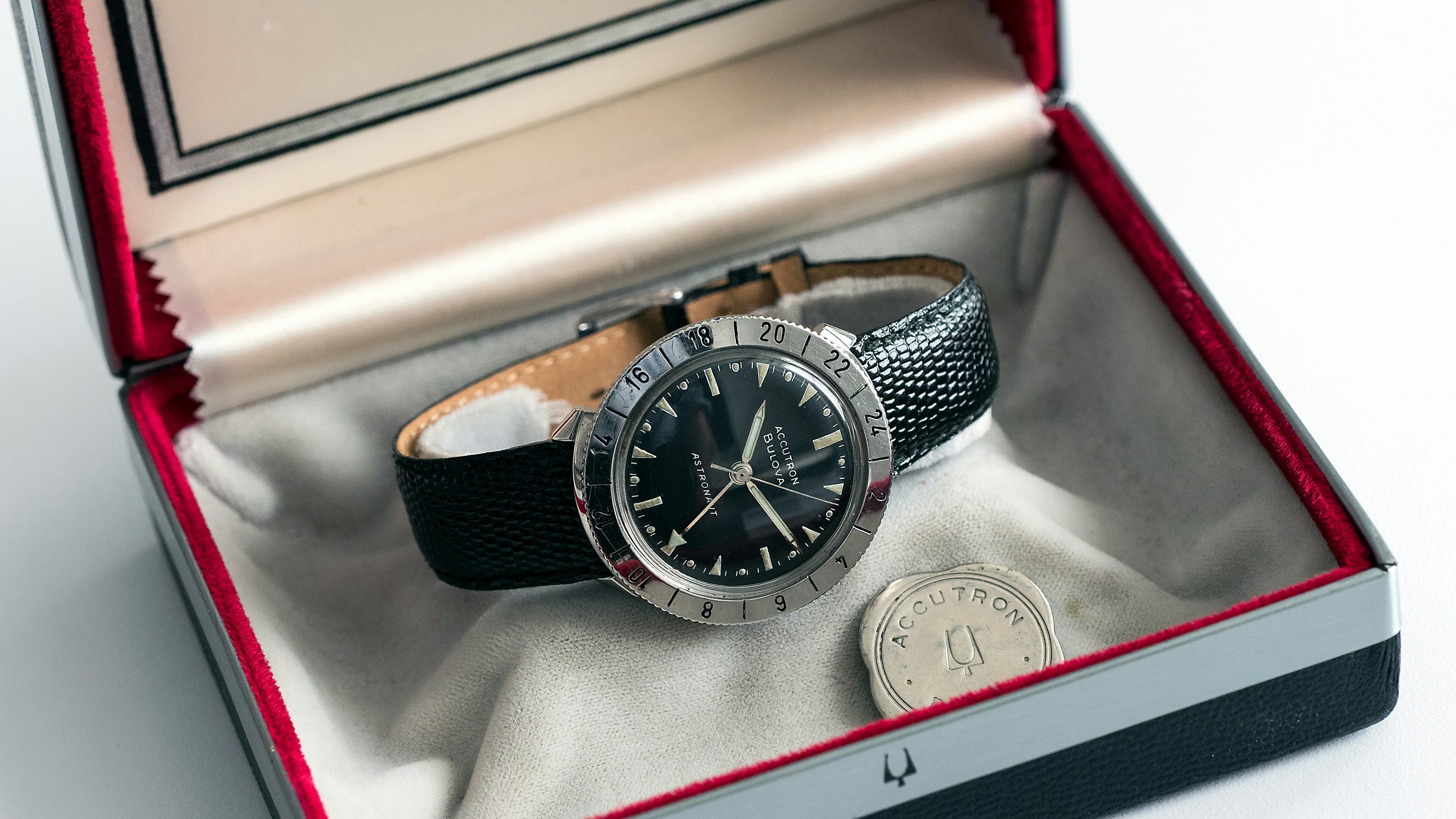
The Accutron is both a watch and a technology, and when the first Accutron tuning fork watches were first released to the public in 1960 they were seen equally zero brusk of revolutionary. Quartz watches were however a decade abroad, and while the Accutron wasn't the showtime electric picket – that honor goes to the Hamilton Electric 500, which debuted in 1957 to much fanfare – information technology was the offset to achieve widespread success. Unfortunately for Hamilton their spotter was rushed into production and exhibited significant initial teething problems, and when the Accutron came forth, the Hamilton Electric 500 was doomed.

The Accutron Astronaut – the picket chosen past the CIA for the A-12 pilots.
The tuning fork mechanism of the Accutron gave information technology unprecedented accurateness and was seen, as well, as marvelous technology, and with unquestioned superiority on its side, Accutron timekeepers and watches found wide acceptance non only from consumers, simply also in the worlds of astronautics and aeronautics – including in the cockpit of the fastest airplane ever made. It'southward a story maybe ameliorate known within the Accutron enthusiast collector customs than in general – perhaps aptly, for a tale and so rooted in Cold War-era secret secrecy. Merely when an aircraft called the A-12 get-go flew as part of a CIA "black aircraft" project, it was the near advanced in the world, and for its pilots, the CIA selected what was and so the earth's most advanced picket.
The A-12 Spy Airplane, And Project OXCART

The A-12 high distance, high speed reconnaissance aircraft, developed for the CIA nether the lawmaking name OXCART. (Image: Wikipedia)
If y'all know something about aircraft, you probably recognize this one immediately – only you might think it's the very closely related plane fabricated for the Air Strength, the famous SR-71 Blackbird. This, however, isn't the SR-71, only the Lockheed A-12 – a very closely related, merely distinct aircraft, which was the SR-71's immediate predecessor. Similar the Blackbird, the A12 was fabricated past Lockheed's famous Skunk Works sectionalization, which handled – and handles – classified aircraft evolution programs for the U.S. military, and U.S. intelligence agencies.
Skunk Works was founded during World War 2, initially to develop a first generation jet fighter aircraft, and in subsequent decades it has, in addition to the SR-71 and A-12, produced some of the most advanced aircraft of their respective generations, in the world. One of the all-time known was the project codenamed HAVE Bluish, which resulted in the F-117 Nighthawk – the world'southward first stealth fighter shipping. A speciality for Skunk Works (which took its proper noun from a moonshine factory in the famous comic strip L'il Abner) has been designing the very fast, and the very stealthy, and the A12 was very both. The need for the A-12 and SR-71 programs was born from the shortcomings of yet another secret shipping project: the high-flying photograph reconnaissance shipping known equally the U-2, operated by CIA too as the Air Force, and nicknamed "Dragon Lady."
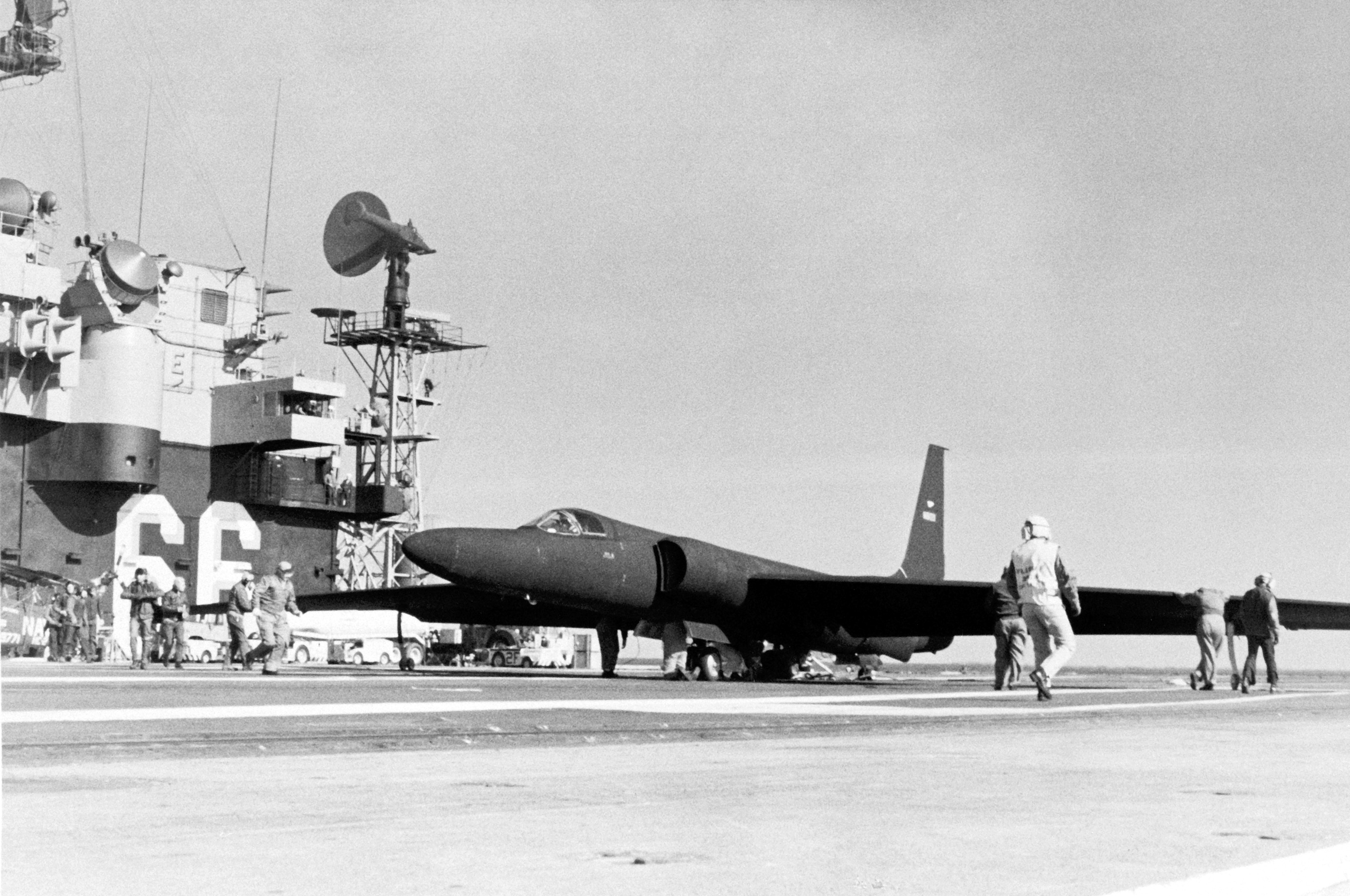
U-2 "Dragon Lady" being flying-tested for carrier operations aboard the USS America.
The U-2 was designed for missions over the Soviet Union and was designed to wing at such high altitudes as to be unreachable by Soviet surface-to-air missiles. The Dragon Lady could achieve altitudes in excess of 70,000 feet – more than than twice the altitude of modern commercial passenger aircraft. However even as it flew its first missions, in 1956, information technology was already clear that sooner or later on, Soviet radar and missile technology would take hold of up to the U-2. It happened, every bit information technology turned out, sooner rather than after; in 1960 a U-two piloted past Frances Gary Powers was shot downward past a Soviet SAM, sparking a diplomatic crunch, and catastrophe the era of of U.S. reconnaissance overflights of the Soviet Union.
Past and so, however, evolution of what would become the A-12 was well along. Both Convair and Lockheed submitted proposals, and Lockheed won the development contract. The project was code-named OXCART, a name chosen from a random word list of hole-and-corner project names, but every bit the A-12 took shape, those working on the projection at Skunk Works became more and more disenchanted with using such a clumsy proper noun for such a groundbreaking aircraft, and the proper name Cygnus (the Swan, a constellation) was adopted at Lockheed. The proper name is now little known however, and the aircraft is generally remembered simply as the A-12.
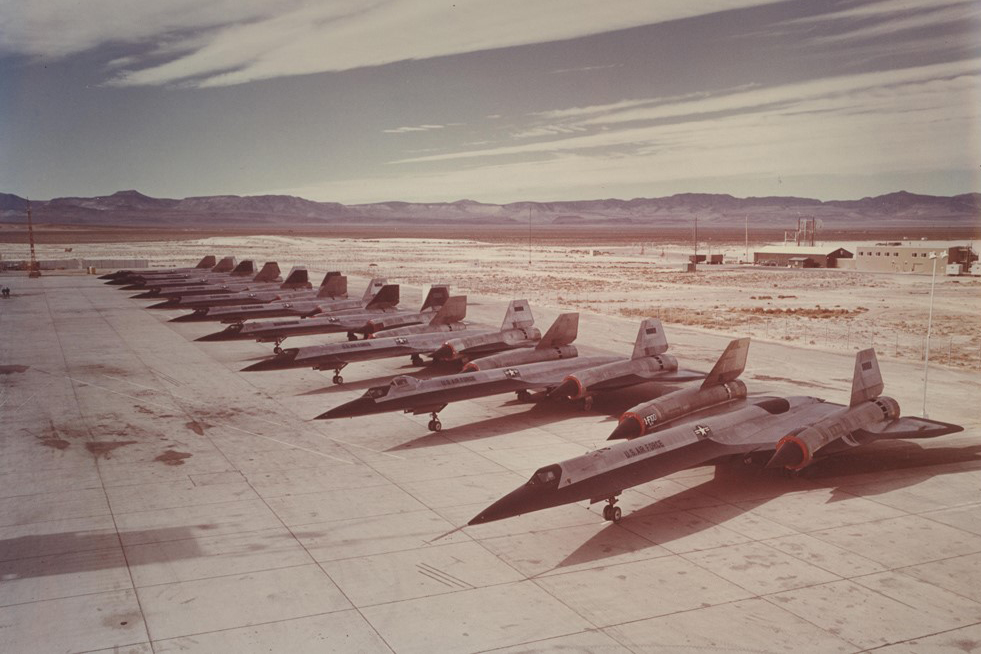
A-12 spy planes on the flight line at Groom Lake, better known as Area 51. (Image: CIA archives)
The A-12, similar its successor the SR-71, was an exercise in extremes. Information technology was literally faster than a rifle bullet, capable of striking speeds in excess of three times the speed of sound and two,000 miles an hour. It could cross the continental USA in lxx minutes, and had a maximum distance of almost 90,000 feet. Not but was it the start Mach three+ capable aircraft, it was as well the first operational stealth shipping. All-encompassing inquiry went into reducing the and so-called radar cross section of the A-12 (that is, how big it "looks" to radar) and bully effort went into optimizing the general shape of the aircraft, and developing specific technology such as the use of special radar-absorbing paint, to brand the A-12 as hard as possible to detect and track in hostile skies.
In the words of its designer, Clarence "Kelly" Johnson, "everything had to be invented" for the A-12, including its fuel. The A-12'due south fuel – a formula called JP-7 – was developed just for OXCART; the spec for it says rather poetically that its aroma "shall not be nauseating or irritating," and that its appearance at room temperature must be "water-white, clean and bright." At well-nigh three times the cost of conventional jet fuel, it fabricated flying the A-12 an expensive undertaking, but the formula was indispensable, for JP-7 had another disquisitional office: cooling.
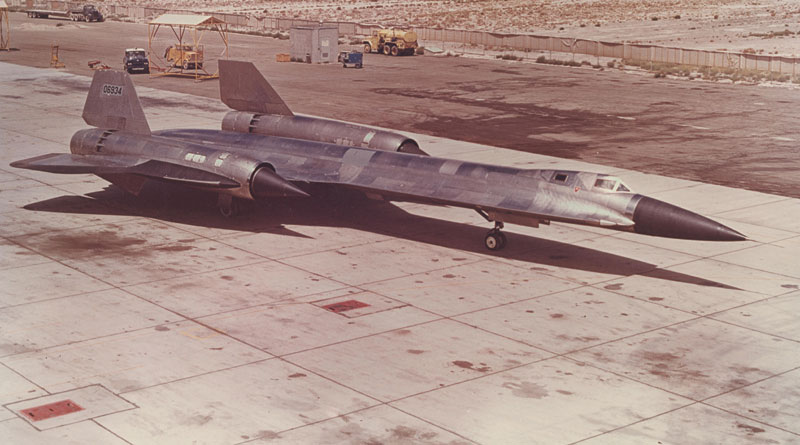
An interceptor version of the A-12 was also made: the YF-12A, designed to shoot down incoming Soviet bombers. (Image: CIA Archives)
At top speed and cruising altitude, the A-12'south titanium peel could reach temperatures of 800 degrees and as JP-seven would corrode conventional fuel tank liners of the twenty-four hour period, the decision was made to use the skin of the aircraft itself as a fuel tank. The fuel thus captivated heat from the outer skin and it had to be formulated so it wouldn't accidentally ignite at such temperatures. Ane story goes that a crew chief actually tossed a lit cigarette into an open container of JP-seven without mishap. To ignite the engines and afterburners, triethylborane was used, which ignites spontaneously in air and burns at a very loftier temperature; the aircraft carried only enough for 16 engine firings. Workload for the A-12 airplane pilot was exacting; deviating even slightly from the correct flight angle (angle of attack) at loftier speeds could cause the aircraft to "depart from controlled flight" with potentially catastrophic results.
The skin of the A-12 was made of titanium and it was the very offset aircraft always to be made entirely of the metallic. Prior to this titanium had only been used for certain parts and the supplier to Lockheed did not take access to sufficient quantities for Project OXCART. The CIA therefore prepare a number of overseas shell corporations to source the material clandestinely from what was at the fourth dimension by far the biggest producer of titanium: the Soviet Wedlock. (To paraphrase something Anthony Bourdain once wrote nearly Russia, ane matter you get a lot of in espionage is irony). The plates making up the skin of the aircraft had to have slight gaps left in between them to let for thermal expansion at superlative speed, and the result was that the A-12 would drip jet fuel onto the runway before takeoff. It was the intense oestrus generated past its faster-than-a-speeding-bullet characteristics that caused the CIA to turn to the Accutron Astronaut every bit a pilot's watch.
The Bulova Accutron Astronaut
The Accutron watch was unlike whatsoever other wristwatch at the time – every bit we've mentioned, there were battery powered wristwatches that preceded it, with prototypes from Lip and Elgin being shown to the public (but not sold at retail) as early as 1952. These however used a conventional remainder cycle and balance spring, with a battery and electromagnetic driving circuit to propel it, rather than a mainspring. While a battery-powered sentinel was something of a novelty, the fact that such watches relied on conventional balances, as well as the fact that the primeval commercial models were very unreliable and expensive, kept them from gaining widespread credence. Perhaps most damning still was the fact that a conventional residual and rest bound, oscillating at the aforementioned rate as a mechanical spotter, cannot in principle produce consistently improve accuracy than a standard mechanical lookout. The Accutron changed all that.

Bulova Accutron Astronaut, from the Bulova Archives.
The Accutron has no balance or rest spring. Instead, information technology uses a tuning fork oscillator, driven by a transistor controlled circuit. The Accutron'southward tuning fork (in the Accutron 214 movement) vibrates at 360 Hz and uses a push-cell battery. Attached to ane limb of the tuning fork is a minute pawl tipped with a well-nigh invisible ruddy precious stone. Every bit the tuning fork vibrates the pawl moves dorsum and forth and this drives an alphabetize wheel with 360 teeth. The alphabetize wheel especially was at the fourth dimension a wonder of miniaturization and micro-technology, with teeth then fine that they are invisible to the naked center. The mechanism has its advantages and disadvantages just like any other slice of engineering, merely the high frequency meant that Accutron wristwatches, clocks, and timing mechanisms offered unprecedented reliability, oft better than one sec/24-hour interval. The fact that they would run on electric power with no requirement for a mainspring too made them highly suitable for use in aerospace applications.
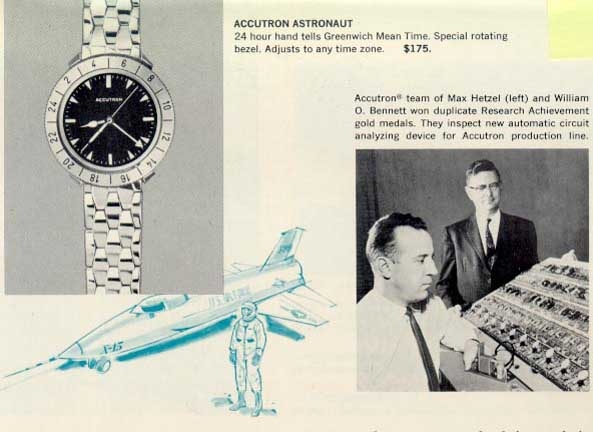
An Accutron advertizing boasting of its use in the X-15 rocket plane program.
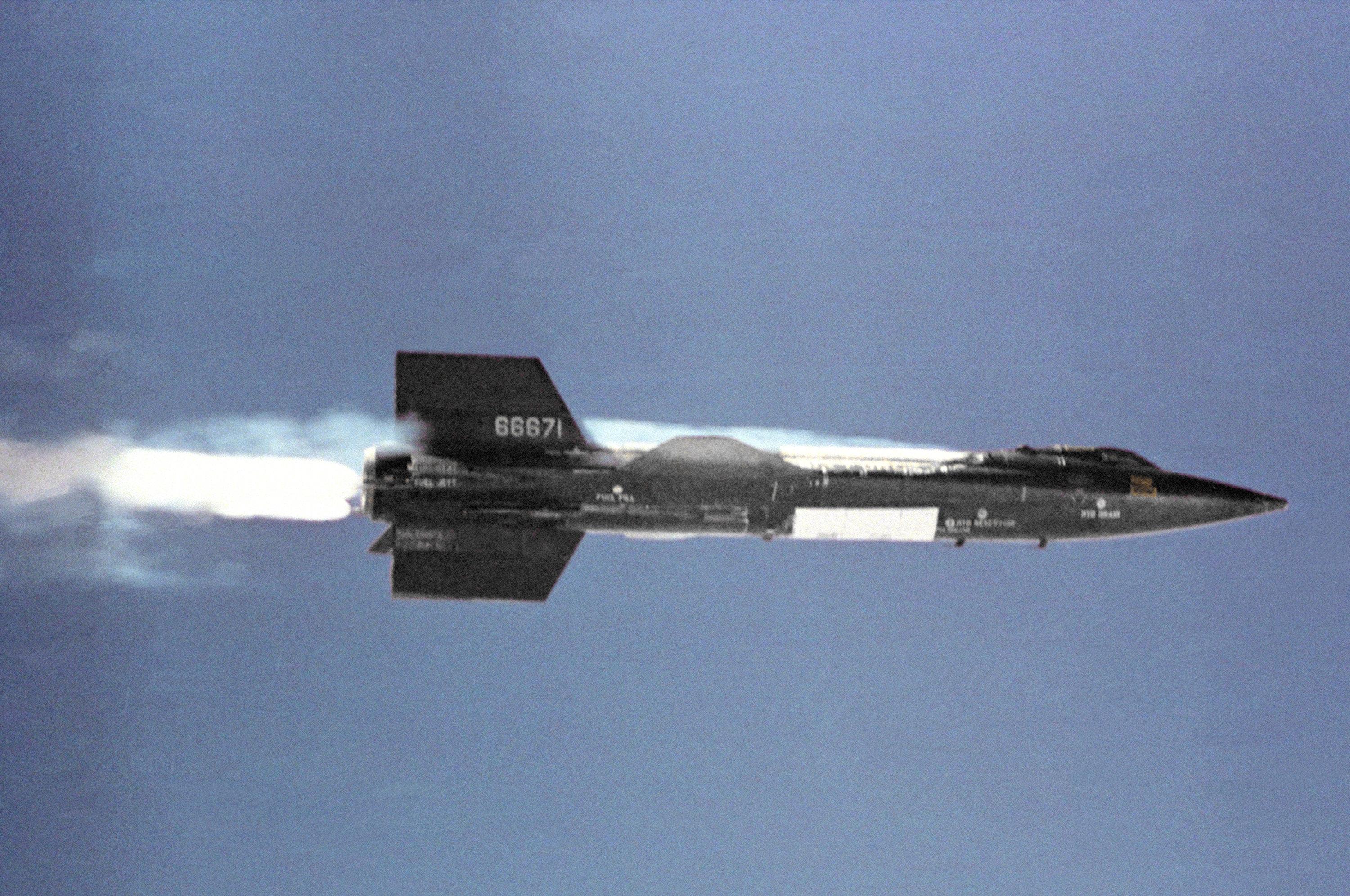
An X-15 hypersonic rocket plane in flight.
Peradventure one of the all-time known users of the Accutron were pilots in the X-15 rocket aeroplane programme. These hypersonic shipping were launched from under the fly of a B-52 Stratofortress at very high distance and flew at speeds of up to four,500 mph. Many X-15 pilots qualified for astronaut'southward wings as they flew high enough to have been considered to have reached the fringes of space.

The Astronaut used an Accutron 214 motion and had a 24-hour hand and bezel.
Though the Accutron had originally been designed equally a consumer product, the structure of the tuning fork mechanism and depression inertia of sure critical components gave it skilful resistance to loftier G-loads and also, a better power to withstand loftier temperatures without becoming inaccurate or otherwise malfunctioning. This led to the adoption of Accutron movements equally cockpit instrument panel timers for manned space flight (they were used throughout the Gemini and Apollo programs) and also made them highly suitable for utilise in the cockpit of the A-12.

The Astronaut was especially chosen for the A-12 program due to its resistance to high temperatures.
The basic trouble against A-12 pilots was succinctly described in a alphabetic character written to Bulova by a onetime A-12 pilot and retired Air Force Lieutenant Colonel, Frank Murray:
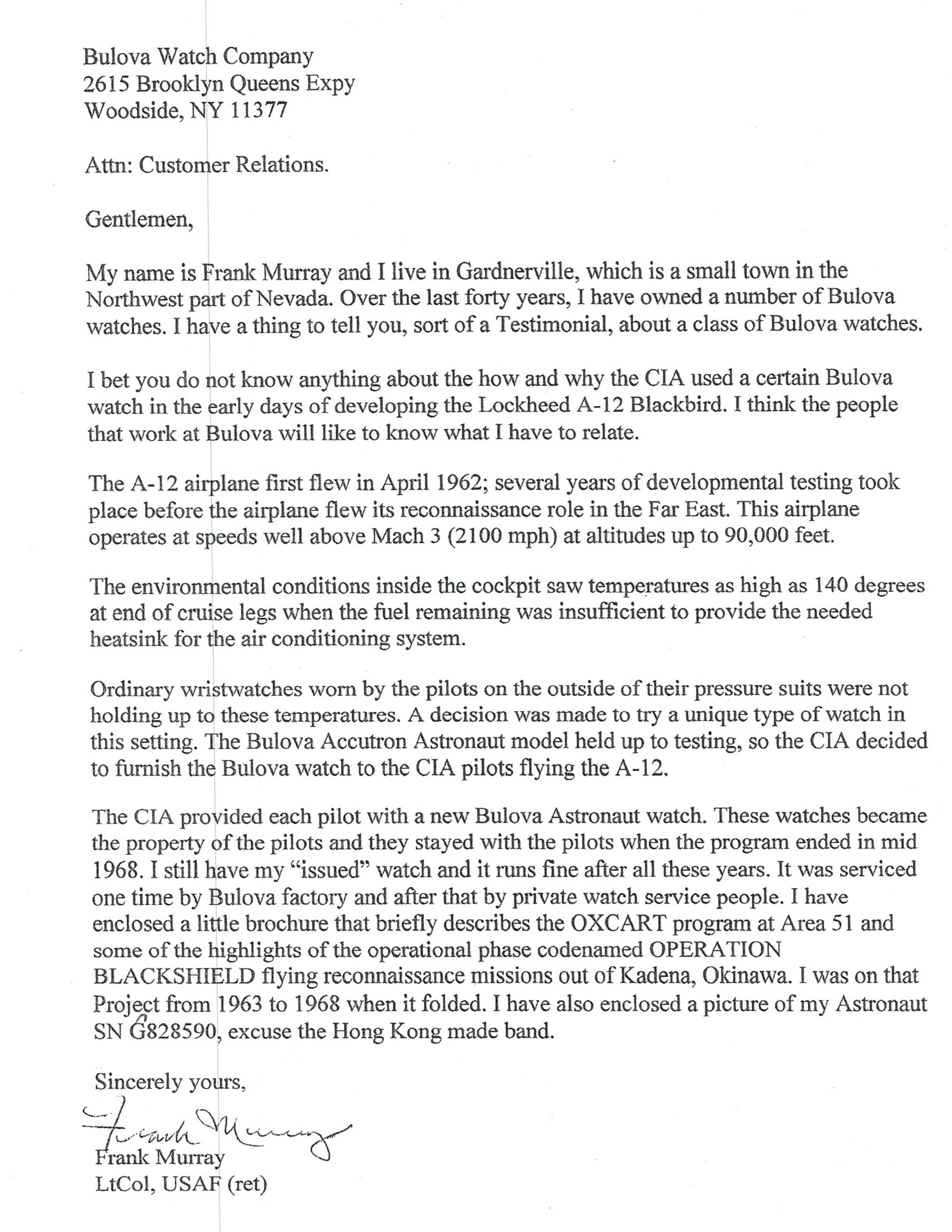
The Accutron Astronaut was in technical terms almost identical to Bulova's other civilian models and it'due south remarkable to reflect that this watch was not originally intended to tolerate the rigors of high-Chiliad acceleration and loftier ambient temperatures such as information technology experienced once again and again in both the Ten-xv and A-12 programs. In addition, the Accutron performed very reliably in such diverse roles equally cockpit instruments in manned space flight, onboard clocks in satellites and fifty-fifty in military applications; the Accutron was used every bit a timer for tracking aircraft in the Nike surface-to-air missile program (Nike missiles were stationed in the continental U.S. as a defense confronting Soviet bombers).

The main difference betwixt the Accutron Astronaut and other Accutron models of its era was the inclusion of a 24-60 minutes hand, and a 24-hour bezel. Like other Accutrons using the 214 movement, the Astronaut has no conventional crown and is set using a recessed central fix into the back of the watch, adjacent to the battery door. Changing the bombardment and servicing an Accutron motion in general required specialized tools and training as the movement, while surprisingly robust in apply, is very delicate on the bench (the same could be said, to some degree, about any watch motion, even quartz) and it would be exceedingly like shooting fish in a barrel to destroy the delicate index wheel teeth or lever-and-pawl mechanisms with fifty-fifty a slight miscalculation with 1'due south tweezers.

The A-12 was non destined to take a long operational life. A single-seat aircraft operating under the say-so of the CIA, information technology was never used in its intended mission of hole-and-corner overflights of the Soviet Union. Instead, the A-12s were flown to Okinawa, and were used equally part of Project BLACK SHIELD, which consisted of a total of 29 sorties flown primarily over North Vietnam, but too over Lao people's democratic republic and Due north Korea, including a mission that located the USS Pueblo after its capture by the N Korean navy in the 1968 incident now known by the proper name of the captured vessel. Lt. Colonel Frank Murray flew four of these missions, and as well flew the last flight e'er of an A-12 when one codenamed "Article 131" was flown from the peak clandestine base at Groom Lake, Nevada, to storage in Palmdale, Arizona. The A-12 was replaced in service past the SR-71, which had 2 seats for both a pilot and a reconnaissance officer, and which was operated until 1998 by the Air Force and 1999 by NASA. In yet another twist of irony, the "Dragon Lady" – the U-ii which the SR-71 and A-12 had been intended to replace – remains in service today, providing a flexibility and versatility still unmatched by surveillance satellites.

As with the A-12, the Accutron was somewhen superseded past more than practical technology – first lower toll quartz watches, which appeared for the first fourth dimension in 1969-70, and so by ubiquitous, atomic-clock-controlled fourth dimension signals served to cell phones. Withal both remain amazing examples of the acme of a sure kind of technological innovation, and the A-12 at least has not been forgotten by the CIA; in 2007 i of the remaining A-12 fuselages was mounted in forepart of CIA headquarters. A CIA commodity on the subject says, "The A-12 arrived at CIA Headquarters aboard five wide-load trucks, and it required two enormous cranes to lift the 39,000-pound airframe onto its three-pylon mount to be assembled in ten days. The pylons hold the airframe in an operational flight attitude at 85,000-90,000 anxiety – its nose up eight degrees and airframe rolled 9 degrees to the left."
The A-12 and its sister, the SR-71 Blackbird, have set speed records that remain unbroken to this solar day and are simply the fastest jet aircraft ever congenital, and it seems, ever likely to be built despite being based on designs from the belatedly 1950s. Likewise, the Accutron as a machinery was a truly ingenious example of only how far mechanical timekeeping can be taken and they remain fascinating instances of an exciting and exotic, and even romantic, catamenia in the evolution of watchmaking.
If yous want to find out more about Lt. Col. Murray'due south career, he'southward a member of RoadrunnersInternationale.com, a website devoted to the A-12 and YF-12 aircraft and a community for those involved with the programs. Read all about the career of the human whose callsign was "Dutch 20" as well as many articles by him on the A-12 programme, correct hither.
Source: https://www.hodinkee.com/articles/bulovas-accutron-astronaut-the-watch-chosen-by-the-cia-for-pilots-of-the-fastest-plane-ever-made
0 Response to "What Causes a Bulovia Spaceview to Run Really Fast"
Post a Comment