What Happens to Stock Price on Ex Dividend Date

Dividend University
Everything Investors Need to Know About Ex-Dividend Dates
When information technology comes to investing, knowing your dates is important. Although long-term buy-and-hold investing means that investors don't actually need to worry nigh the quarterly dates tied to dividend payouts, it'southward still helpful to exist familiar with the terms. Likewise, more than aggressive traders tin actually use dividend dates equally part of an alpha-generating strategy, including the dividend capture strategy.
The All-important Dividend Dates
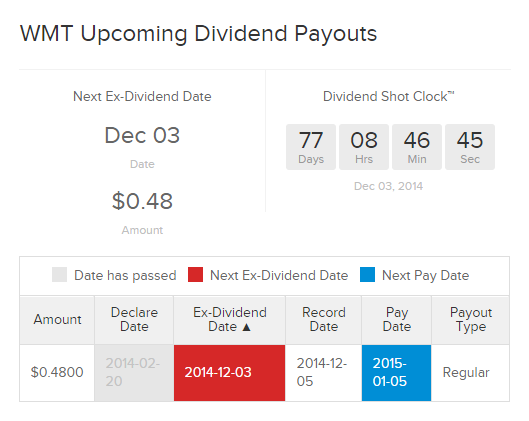
At that place are iv main dates that investors need to keep in listen for dividend-paying stocks. All of these dates can be found on our Dividend Stock Ticker Pages, every bit pictured beneath.
1. Declaration Date
The declaration date is the day that the company declares that it will pay a dividend. With this declaration, the visitor announces how much it will pay, the ex-dividend date, and the payment date. The declaration appointment is sometimes called the "announcement date" and most reliable dividend-paying companies keep to a regular declaration schedule (adjusting for weekends and holidays, of course). Likewise, companies generally now announce changes to their dividends forth with earnings announcements or in separate press releases.
Declaration dates tin exist more meaning for foreign companies, where payouts are often based as a consequent percentage of profits and where it is less common to "pre-announce" changes to the dividend.
2. Ex-dividend Date
Equally of the ex-dividend appointment, buyers of this stock will no longer be entitled to receive the declared dividend and the stock is said to thereafter trade "ex-dividend" (without dividend). Before trading opens on the ex-dividend date, the exchange marks downwards the share price past the amount of the declared dividend.
As an instance, ABC Inc declares a $ane dividend with an ex-dividend engagement of Jan 10th. Anybody who buys the shares on the 7th, 8th, or 9th—or whatever date prior to the 10th—will get that dividend. When the stock opens on the tenth, it will be adjusted down past $1 from the ninth's endmost price. Anybody who buys on the 10th or thereafter will not become the dividend.
Another important note to consider: as long every bit you purchase a stock prior to the ex-dividend date, you can so sell the stock whatsoever fourth dimension on or subsequently the ex-dividend date and yet receive the dividend. A common misconception is that investors need to hold the stock through the tape engagement or pay appointment.
Ex-dividend dates are the single near important date to consider whenever ownership a dividend-paying stock. Thus, nosotros strongly encourage readers to use our ex-dividend calendar.
three. Record Date
The tape engagement is simply the date where the company looks at its ledger and determines to whom they send the dividend checks ("the holders of record"). At present, the record date is always the next business day after the ex-dividend date (business concern days being not-holidays and not-weekends). This date is completely inconsequential for dividend investors, since eligibility is determined solely past the ex-dividend engagement.
4. Payment Date
Every bit the name suggests, the payment date (or "pay date") is the date on which a visitor actually pays out its dividend. Generally speaking, this date falls about 2 weeks to one month after the ex-dividend date.
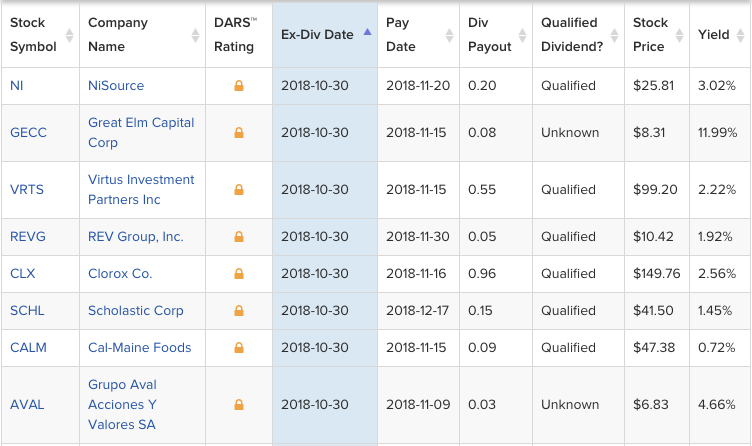
Investors can use the Ex-Dividend Appointment Search tool to track stocks that are going ex-dividend during a specific appointment range. Ex-dividend dates are extremely important in dividend investing, because yous must own a stock before its ex-dividend date in club to be eligible to receive its next dividend. Check out the below screenshot of the results for stocks going Ex-Dividend on October thirty, 2018.
Go to the tool now to explore some of the costless features.
Dividend Capture: Slow Idea to Dynamic Trading Strategy
Although investing in dividend-paying stocks and collecting those regular payments is considered consummately bourgeois disinterestedness investing, there are much more aggressive means to play the dividend cycle. We want to emphasize that "ambitious" part — dividend capture is a type of trading and it carries above-normal risks and potential tax consequences.
In essence, dividend capture strategies aim to turn a profit from the fact that stocks do not always trade in strictly logical or formulaic ways around the dividend dates. For instance, while a stock is marked down before trading begins on the ex-dividend date by the amount of the dividend, the stock does not necessarily maintain that adjustment when actual trading begins (or ends) that day. Likewise, the desire to reap the benefit of the upcoming dividend often spurs interest in the stock ahead of the ex-dividend date, leading to short periods of outperformance. For more than dividend education, check out The Truth About The Dividend Payout Ratio.
In its simplest form, dividend capture can involve tracking those stocks that, for any reason, exercise not generally trade downward by the expected corporeality on the ex-dividend appointment. To harken back to the hypothetical ABC Corp, investors may find that although ABC pays a $1 dividend, the stock only declines by an average of $0.fifty on the ex-dividend appointment. That existence the example, an investor tin can buy the stock on the day prior to ex-dividend (say, for $100), sell it on the ex-dividend date (say for $99.50), and collect the $1 dividend a few weeks afterward, leading to a total return of $0.50 on the trade (losing $0.50 on the stock, but gaining the $one dividend).
A few words are in guild about this strategy. First, considering the stock is held for less than 61 days, the dividend is not eligible for the preferential tax handling that qualified dividends go, though the capital loss on the stock trade offsets that to some extent. 2d, this assay does not include trading costs or the time value of money. If it costs more than $0.l per share to practice the trade and/or that coin could earn more than $0.50 per share in interest, information technology makes no sense to exercise the trade.
At that place are more involved/longer-term dividend capture strategies also. Equally some stocks practise prove a tendency to merchandise higher into the ex-dividend engagement, information technology can be possible to buy the shares ahead of time (sometimes even 61-plus days alee, thereby triggering qualified dividend eligibility) and reap outsized returns by selling the stock on or before the ex-dividend date. Likewise, at that place are strategies involving options that take advantage of like aberrations, simply those are beyond the scope of this article.
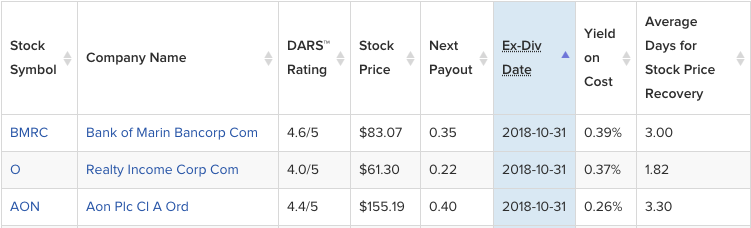
The key to successfully executing the Dividend Capture Strategy is to find stocks that recover apace after committing to a dividend payment and timing information technology right in order to minimize the risk from holding the stock. We've created a tool to assistance you practice only that! Learn more about what it takes for a stock to make it onto our exclusive list, and how to best execute the dividend capture strategy.
Beware of the Risks?
So why doesn't everybody capture dividends? For starters, academics will tell you that it can't work — dividend capture is basically a course of arbitrage and market theory holds that savvy market participants will ensure that whatsoever "piece of cake money" opportunities similar this quickly vanish. To that end, it does seem to be the case that once people start widely discussing particular dividend capture stocks, those strategies seem to stop working.
Also, dividend capture is not a risk-free or price-free strategy. The commission charges to arrive and become out apply whether you brand money or not, and investors pursuing dividend capture often notice that they must execute the strategy across multiple names to diversify the chance. That ties up capital, which carries its own not-always-obvious costs.
The Bottom Line
Last and not least, this strategy takes a lot of work. Information technology takes lots of enquiry to discover suitable candidates, it takes an appetite for take a chance to pursue the strategy, and it takes discipline and attention to item to successfully execute. Capture is absolutely non a strategy for the "I'll do it tomorrow" oversupply, and quite frankly not all investors are going to notice that the potential rewards (subsequently subtracting the costs and those dividend capture attempts that neglect) are worth the effort.
Dividend.com's tools assist investors make sound investment decisions. Investors can narrow down their stock investment search by screening, comparing and analyzing the vast universe of dividend-paying stocks.
Check out the consummate list of our tools now.
Source: https://www.dividend.com/dividend-education/everything-investors-need-to-know-about-ex-dividend-dates/
0 Response to "What Happens to Stock Price on Ex Dividend Date"
Post a Comment